



An AI answer can explain what a failing septic system looks like without ever recommending your company to fix it.
It can describe the steps involved in preparing a building site without making you the contractor a homeowner calls.
That is the gap many AEO conversations miss. Teaching AI about a service and helping a customer find, verify, and hire your business are not the same thing.
For excavation and septic contractors, the goal is not to collect a screenshot where your name appears. It is to make your company easier to discover, harder to misunderstand, and simpler to contact when someone needs work you actually perform.
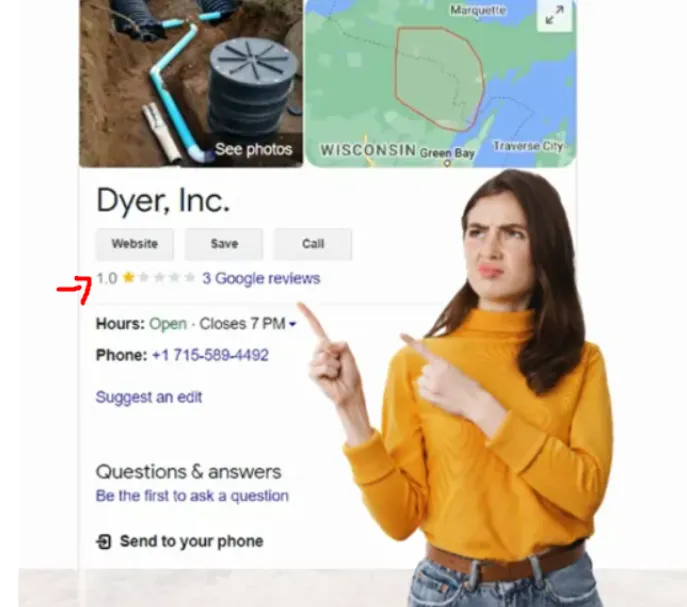
You may already have good reviews, experienced crews, and a website. The next question is whether your online information accurately represents that business when a homeowner starts researching through Google or an AI assistant.
AEO Should Strengthen Your SEO, Not Replace It
Answer engine optimization, usually shortened to AEO, is an industry term for work intended to improve how useful business information appears in answer-driven search experiences. For a local contractor, that means helping people understand your services and evaluate your company, whether they encounter a traditional search result or an AI-generated response.
It does not mean SEO is obsolete. Google's current guidance says optimizing for its generative AI search is still SEO. Your useful service pages, technical accessibility, accurate business information, and customer-focused content still matter.
Do not stop working on Google Maps or abandon a good website because someone promises a special AI shortcut. Improve the foundation you already have. An inaccessible septic installation page does not become more useful because you add another paragraph about artificial intelligence.

Being Cited Is Not the Same as Being Recommended
Consider two questions a homeowner might ask: “What affects the cost of a new septic system?” and “Who installs septic systems in my county?”
The first asks for an explanation. The second asks for a suitable provider. Your cost guide could be used as a source for the first answer without your company being recommended for the second.
The same applies to excavation. An explanation of foundation excavation may help someone understand the work, but that is different from being identified as a contractor serving their property.
OpenAI says placement in ChatGPT Search is not guaranteed. A citation is not a booked estimate. Absence from one response also does not prove your company is invisible everywhere. Judge the information and outcomes, not one impressive screenshot.
Make Sure Your Important Pages Can Be Found
Before creating more content, ask your website provider whether search systems can access your existing service pages.
For Google's generative AI search features, a page must be indexed and eligible to appear with a search snippet. Google's current guidance also points to the Search Console setting controlling inclusion in its generative AI features. Inclusion is the default, but your provider should check the actual setting rather than assume it.
Start with the pages that support the work you want more of: septic installations, system replacements, site preparation, foundation excavation, or land clearing. Are they indexed? Can they be reached through the site's navigation? Does the useful information appear as readable page text rather than only inside an image?
Ask about accidental indexing restrictions and firewall rules that might block legitimate search access. That is a targeted technical review, not a reason to disable your site's security. Accessibility creates eligibility. It does not guarantee selection.
Ask Your Website Provider One Simple Question
You do not need to learn the technical side of AI to take this step. Ask the person who manages your website: “Can ChatGPT Search find and read the pages about our septic installations, excavation work, and other services, or are our website settings blocking it?”
There is also an important difference between letting ChatGPT search your website for information and allowing your content to be collected to help train its AI models. OpenAI allows those permissions to be managed separately. You can allow access for search without also allowing access for training.
Your website provider can check those settings while keeping your site's security protections in place. You do not need to give every AI service unrestricted access to your website.
The goal is to avoid accidentally blocking search tools you want homeowners to use to find you. Fixing an access problem does not guarantee ChatGPT will recommend your company, but it addresses a possible barrier to discovery.
Tell People Exactly What You Do and Where You Do It
A homepage saying “We handle all your property needs” leaves important questions unanswered.
Do you install new septic systems, replace existing systems, or only pump tanks? Does your excavation work include foundation excavation, building pads, land clearing, grading, and site preparation? Which areas do you actually serve?
Put those answers on the relevant pages. Explain your assessment process and give the homeowner a clear next step. Do not assume a photograph of an excavator communicates every service your company provides.
Keep your business name, contact details, hours, and service information accurate across your website and business listings. Microsoft specifically highlights accurate Bing Places information when discussing local AI visibility. Google Business Profile deserves the same operational attention as part of your broader local presence.
Be honest about emergency availability, licensing, and travel limits. A homeowner who discovers the wrong service information is not a better lead just because the discovery happened through AI.
Improve One Service Page Before Writing Ten More Blogs
Suppose new septic installations are a service you want to grow. Look at that page from the homeowner's perspective.
Explain whether you work on new construction, replacements, or both. Describe what information your office needs before arranging an assessment. Address the factors that can change project scope, including property conditions, access, system requirements, and the approval process in your area.
Then show genuine installation work and explain what the customer can expect next. Avoid quoting a universal price or promising an installation timeline before the necessary assessment and approvals.
For foundation excavation, explain the project types you handle, what plans or site information are needed, and which responsibilities belong to your crew versus the builder or other professionals. A useful service page should help someone decide whether contacting you makes sense.
Those improvements serve real customers. They are not a special writing formula that forces an AI system to select your business.
Answer the Questions That Affect a Hiring Decision
Broad definitions are easy to find. The more useful opportunity is answering the questions that determine whether a homeowner is ready for a conversation.
For septic work, that might be: “Can you assess a replacement before I buy the property?” or “What information do you need to discuss a new installation?” For excavation, it could be: “Can you clear the lot and prepare the building pad?” or “What should I have ready before requesting foundation excavation?”
Use the questions your office hears repeatedly. Give a direct explanation, then enough detail to prevent misunderstandings. A short answer is useful only when it is accurate and complete enough for the situation.
Google says you do not need a special writing style for generative AI search. Write naturally because homeowners need to understand you, not because a particular sentence length supposedly unlocks AI recommendations.
Use Proof That Belongs to Your Business
A claim such as “We are the area's trusted excavation experts” is less useful than a clear example of work your team completed.
Show permission-cleared project photos. Explain the customer's objective, the site's constraints, and what your crew actually did. Include genuine customer feedback when appropriate, without inventing quotes or suggesting results you cannot support.
A septic installation example might explain how your company coordinated its work with the required design and approval process. An excavation example might show the preparation of a building pad or foundation area and describe the agreed scope.
Name the knowledgeable person who wrote or reviewed technical explanations. Link to the relevant authority when discussing local permits or requirements. These details help customers evaluate your experience. They are not a guaranteed AI citation formula.
Be Clear About What Requires an On-Site Assessment
A good answer does not pretend every property has the same solution.
A homeowner researching wet ground near a septic system may need professional evaluation, not an online diagnosis. A building site may have access, soil, grading, or permitting issues that change the plan.
Explain what can be discussed initially and what must be confirmed on site or with the appropriate authority. Requirements can vary by jurisdiction and project. Your content should make those limits clear rather than turn a general explanation into a promise.
Specific, honest answers also support better intake. They help your office understand the request before spending hours on an estimate that does not fit the work you perform.
Do Not Buy a Magic-Schema Promise
Structured data is a way of describing page information in a machine-readable format. Appropriate markup can support certain search features, but it should accurately reflect the content people can see.
Google says no special schema markup is required for its generative AI search. Its guidance also says files such as llms.txt do not improve Google Search visibility. Those statements are about Google, not every AI product.
Useful FAQs can still help customers, but Google retired FAQ rich results starting May 7, 2026. Adding FAQ markup is not a promise of a special search display. Likewise, marking up reviews of your own company on your website does not make those pages eligible for Google's self-serving LocalBusiness review-star feature.
Use sensible technical work where it applies. Do not confuse a code installation with a business result, or let it replace the service information and proof your customers need.
Measure Visibility, Visits, and Inquiries Separately
You need to know what a measurement actually represents before deciding whether AEO is working.
Google's Generative AI performance report reports impressions for supported features such as AI Overviews and AI Mode. It is not a report of booked septic installations or excavation projects, and it may not appear when a site lacks sufficient impressions.
Bing's AI Performance reporting shows citation activity across supported Microsoft and partner experiences. A citation count is not a search ranking, a visit count, or a complete record of every ChatGPT interaction.
Use website analytics to review identifiable referral visits, then review qualified inquiries separately. Your office can record what the homeowner remembers about finding you, but that answer is supporting context rather than perfect attribution.
Someone may discover your company in an AI response, search your name on Google, and call later. Not every step will be visible. Keep that limitation in mind before claiming that one content update caused a particular job.
Start With a Practical Improvement You Can Verify
You do not need to rebuild your marketing around an acronym this week.
Choose one commercially important service page. Ask your provider to check search access. Confirm its service and area information. Add the hiring questions your office actually hears, genuine project proof, and a working contact option that is easy to use on a phone.
Save a baseline of the available visibility and inquiry data before the change. Review the results over time and account for seasonality or other marketing changes. This is a practical test, not a guaranteed thirty-day ranking program.
Once that page is useful, apply the same process to the next priority service. Keep normal SEO and local marketing working while you improve your readiness for AI-assisted discovery.
Be Found, Trusted, and Easy to Hire
The best AEO strategy for an established contractor does not begin with feeding a machine more words. It begins with making the real business easier to understand.
Be clear about the septic and excavation work you perform. Show evidence that belongs to your company. Keep important information current. Give homeowners a sensible way to request an assessment, and have your office ready to respond.
No marketing provider can guarantee your company will appear in every AI answer. You can build a stronger foundation for discovery and a better experience for the homeowner who finds you.
Send us a message today to find out how Excavation Marketing Pros can help excavation and septic contractors improve their service content, identify search visibility gaps, and make it easier for the right homeowners to take the next step.













Facebook
Instagram
X
LinkedIn
Youtube
TikTok