





Adding another crew can feel like the obvious next move when the phone is ringing, the schedule is full, and customers are asking how soon you can start.
For an excavation or septic company owner, that pressure is real. You may be turning away work. Your estimator may have more site visits than time to quote. Your current crews may be working long days, skipping the small details that protect customer experience, or pushing jobs farther into the calendar than you are comfortable with. It is easy to look at the demand and conclude that one more truck, one more operator, and a few more hands will solve the problem.
Sometimes that is exactly right. Other times, adding a crew too early turns a profitable company into a stressed company with more payroll, more equipment payments, more customer expectations, and not enough dependable work to support it.
The decision should not be based on one busy month or a handful of jobs you could not fit in. It should be based on a clear picture of backlog, lead flow, close rate, cash flow, equipment, staffing, and how consistently your company can turn demand into well-run work.
The best time to add another crew is not when the owner is overwhelmed. It is when the business has enough evidence that the next crew can stay productive, profitable, and properly supported without forcing the owner to gamble on every decision.
A Full Schedule Is Not the Same as a Healthy Backlog
Many contractors decide to add a crew because the calendar is packed. That is a useful signal, but it is not the whole answer.
A full schedule can come from a temporary rush, a weather delay, a crew that is underperforming, a large project that has shifted work into the future, or an office process that is slow to confirm and hand off jobs. Before you add payroll and equipment, separate a calendar that is merely congested from a backlog that represents profitable, ready-to-start work.
A healthy backlog means you have signed work with realistic start dates, clear scopes, deposits or payment expectations where appropriate, and enough margin to support the people and equipment required to complete it. It also means the work matches what the next crew is built to do. A backlog made up mostly of complex septic replacements may not support a crew set up for pumping, inspections, and repairs. A backlog of small drainage or driveway jobs may not justify a major equipment purchase unless the production model is clear.
Look at how many weeks of work are truly committed at your current production rate. Then look at whether fresh signed work is replacing what your crews complete. If the backlog stays strong only when the owner works nights to write estimates or only because a single large project is delaying everything else, that is not yet proof of sustainable capacity.
The question is not, "Are we busy today?" The better question is, "If we add a crew, will we still have profitable work ready for them after the first few weeks?"
Lead Flow Has to Be Consistent Enough to Feed the New Capacity
A new crew needs more than a busy phone. It needs a predictable source of the right kinds of opportunities.
Excavation and septic contractors often receive a mix of emergency calls, routine service requests, small repairs, large replacement projects, site-prep inquiries, drainage work, and jobs that are outside the service area or not a good fit. More calls do not automatically mean more revenue for another crew. What matters is whether the business is consistently generating the qualified leads that fit its services, service area, equipment, and desired job size.
Start by looking at several months of lead data rather than relying on the last few weeks. Which services produce the most qualified opportunities? Which towns and neighborhoods create jobs that are worth the drive? Which lead sources create homeowners who are ready to make a decision, and which ones create price shoppers who rarely move forward?
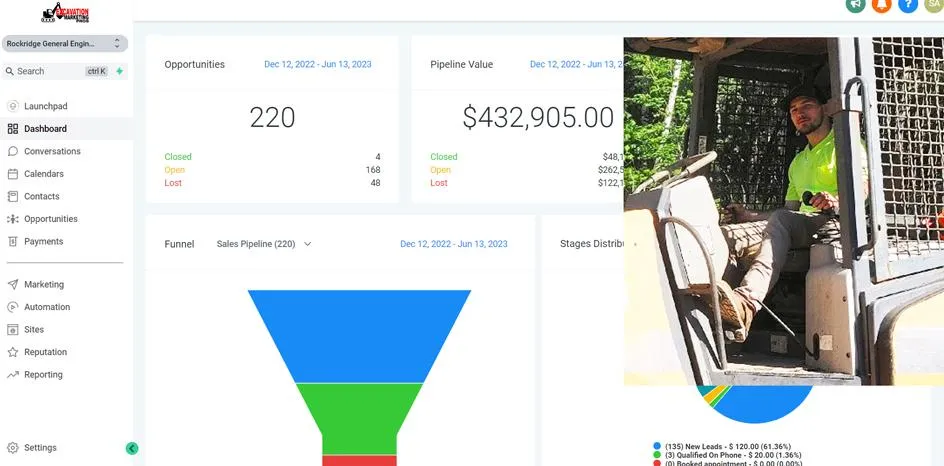
A strong marketing system makes this easier to answer. Your CRM should show the source of each lead, the service requested, the outcome, the estimated value, the actual sold work, and the next action. If you cannot see that information today, it is difficult to know whether a new crew will be supported by real demand or by optimism.
For septic contractors, you may find that pumping and inspection requests create a reliable entry point for future repairs, replacements, and maintenance work. For excavation contractors, you may find that certain project types, neighborhoods, builders, or referral sources consistently create well-scoped work. That knowledge tells you what to market more aggressively before hiring another crew.
A company that can trace lead flow to booked jobs is in a much stronger position to add capacity than one that simply hopes more calls will appear after the new crew starts.
Your Close Rate Reveals Whether Demand Is Real or Leaking Away
A backlog measures the work already sold. Your close rate shows whether future work is likely to keep coming.
If your team is receiving good leads, completing site visits quickly, delivering clear estimates, and following up consistently, your close rate becomes a practical planning tool. It tells you how many qualified opportunities you need to win a certain amount of work. If you know the average value and gross-profit contribution of the jobs you close, you can estimate how much lead flow and sales activity the next crew needs to stay productive.
Do not confuse a high close rate with a reason to add a crew without looking deeper. A close rate can look strong because you are only quoting the easiest work, because you are priced too low, or because the owner personally handles every estimate. The more useful measure is whether you are winning the jobs you want at the margin you need while serving customers on a timeline that supports your reputation.
Pay attention to estimates that go quiet after they are sent. That silence may be a price concern, a slow response problem, unclear scope, lack of financing options, or simply a missing follow-up process. If your close rate improves when you respond faster and follow up professionally, you may have more capacity available in your existing team than you realized.
Before adding a crew, tighten the estimate process. Make sure leads are qualified, site information is captured, proposals are sent promptly, and every active estimate has an owner and a next step. Then your sales pipeline becomes a reliable indication of whether the company can feed another crew instead of a collection of guesswork.
Cash Flow Must Carry the Crew Before the Crew Produces Full Revenue
A new crew costs money long before it produces a steady stream of completed, collected jobs.
There may be payroll before the first job starts. There may be recruiting time, training hours, insurance changes, fuel, repairs, tools, workwear, mobile devices, permits, material deposits, and equipment payments. There may be a ramp-up period while the crew learns the company standard, becomes efficient with the equipment, and develops the communication habits that prevent callbacks and rework.
This is why revenue alone is not a good test. A business can have a strong year on paper and still struggle to fund a new crew if receivables are slow, job deposits are inconsistent, equipment debt is already heavy, or too much cash is tied up in work that has not been invoiced.
Look at your cash position honestly. Can the business cover the full cost of the new crew for a reasonable ramp-up period without delaying payroll, skipping maintenance, relying on credit for ordinary operating expenses, or putting pressure on the owner to take every low-margin job that comes in? Can you still handle an unexpected repair, weather disruption, or a customer payment delay?
For established excavation and septic companies, the goal is not to eliminate all risk. Growth always requires judgment. The goal is to make sure the business is funding the growth with planned cash flow, not hoping the next few jobs arrive at exactly the right time.
A monthly cash forecast should show expected collections, payroll, equipment payments, overhead, material needs, and the minimum cash reserve you want to protect. When that forecast says the business can carry the ramp-up without creating panic, the crew decision becomes much safer.
Equipment Capacity Is More Than Owning Another Machine
It is tempting to think another crew begins with another excavator, truck, trailer, or vacuum unit. Equipment matters, but it is only one part of the capacity equation.
A new crew also needs dependable access to the attachments, tools, transportation, maintenance support, materials, and jobsite logistics that allow them to work efficiently. A crew that waits for a shared machine, searches for tools, borrows trailers, or loses half a day to unplanned maintenance is not really an additional crew. It is another set of payroll costs competing for the same limited production resources.
Before purchasing or financing equipment, look at how your current fleet is used. Are the machines actually productive for most of the week, or are they idle because estimates, permits, materials, customer decisions, and scheduling handoffs are slowing the work? Are you turning away jobs because you lack equipment, or because the owner has no time to quote and schedule them properly?
For septic contractors, consider whether the next crew needs a dedicated service truck, pumping unit, inspection equipment, repair tools, or installation support. For excavation contractors, consider the machine size, transport setup, attachments, operator skills, and support equipment that match the work you want to win. The right equipment decision follows the service mix. It should not lead it blindly.
A clear equipment plan includes more than the purchase price. It includes maintenance expectations, backup options, operator training, storage, insurance, downtime planning, and how the asset will generate enough productive work to justify its cost.
The Right Crew Leader Is More Important Than the Extra Labor
Adding people without adding leadership often creates more owner dependence, not less.
A second crew needs someone who can manage the jobsite, protect the scope, communicate with homeowners, document changes, keep the work moving, and bring only the important decisions to the owner. If every crew question still leads to a phone call, the owner may end up working harder with two crews than they did with one.
The best crew leader may already be in your business. It could be a dependable operator, technician, foreman, or installer who understands the company standard and wants more responsibility. But promotion should come with training and clear authority, not just a new title. The person needs to know what work is expected, what quality looks like, how to communicate a change order, how to document a problem, when to contact the office, and when an issue must be escalated to the owner.
If you plan to hire a crew leader from outside the company, build the onboarding process before they arrive. Give them a detailed job handoff system, customer communication expectations, safety procedures, equipment standards, and a clear first-month plan. A capable person cannot perform well if the company has not made the information and authority available.
For both excavation and septic contractors, the second crew should be designed to make the owner less central to routine decisions. If the new crew cannot operate within a defined system, the company is adding capacity without adding control.
Your Office and CRM Need to Support the Work Before You Multiply It
More crews create more calls, more schedule changes, more estimates, more customer updates, more invoices, and more chances for a detail to fall through the cracks.
That is why a company should review its office systems before expanding field capacity. Can someone other than the owner answer and qualify new calls? Are customer details, photos, job notes, permits, contacts, and next steps saved in one place? Does the estimator know what information needs to be collected before a site visit? Can the office see whether an estimate is waiting, a deposit has been received, a job is ready to schedule, or a crew needs material confirmation?
A CRM does not have to be complicated to create control. It should give the team a clear view of each lead and job, who owns the next step, and what needs to happen before the customer is left waiting. The schedule should be visible. The job handoff should be consistent. The office should know when it can solve a problem and when it needs the owner.
If your present crew is doing good work but your office relies on scattered texts, memory, and last-minute calls, adding another crew will expose the weak spots fast. Build the operating system first. Then the new crew has a better chance of producing revenue instead of creating more chaos.

Demand Should Be Strong Enough to Support the Crew in Slow Weeks Too
Every excavation and septic company has seasonal patterns. The work may surge when the ground conditions are favorable, when homeowners are preparing for a sale, when builders are active, or when emergencies rise. The same business may experience slower periods because of weather, holidays, permitting delays, homeowner budgets, or changes in local construction activity.
Before you add a crew, ask what happens in the slower weeks. Do you have service work, inspections, repairs, maintenance programs, drainage work, or follow-up projects that can help keep the team productive? Do you have a marketing system that keeps your company visible when referrals slow down? Do you know which services you should promote when the most profitable work is less available?
This is where marketing and operations must work together. A second crew is easier to support when the company has a plan to market services that fit the season, follow up on old estimates, reactivate past customers, ask for reviews and referrals, and maintain local visibility before the calendar is empty.
The company does not need every day booked months in advance. It needs evidence that it can create and convert enough qualified demand across the year to support the new capacity without discounting the work just to keep people busy.
Add the Crew When the Business Can Support the System, Not Just the Payroll
The right decision comes from a complete picture.
You are likely ready to add another crew when the backlog is made up of profitable, ready work; qualified lead flow has been consistent over time; estimates are being followed up; cash flow can cover the ramp-up; equipment is planned and available; a crew leader can operate with real authority; and the office has a system to keep the new work organized.
You may need to wait when the calendar is full because the owner is the bottleneck, the sales process is inconsistent, cash is tight, current equipment is poorly utilized, or the team has no one prepared to lead the next crew. Waiting is not failure. It is a chance to build the systems that make growth more profitable and less stressful.
For established excavation and septic contractors, another crew can be a major step toward bigger jobs, better response times, and a stronger company. But the crew is only as valuable as the sales, operations, marketing, and leadership system behind it.
Send us a message today to find out how Excavation Marketing Pros can help your excavation or septic company build the marketing, CRM, intake, and follow-up systems that create dependable demand before you add more capacity.













Facebook
Instagram
X
LinkedIn
Youtube
TikTok