



“We get most of our jobs from Google.”
That sounds like a clear answer until you ask which part of Google.
Did the homeowner call from your Maps listing? Click an unpaid service page? Select a sponsored ad? Or search your company name after a neighbor recommended you?
Those are different paths to the same phone. If you treat them as one thing, it becomes easy to buy the wrong service, expect the wrong result, or shut off something that was doing its job.
For established excavation and septic contractors, this is not a lesson in marketing vocabulary. It is a practical way to understand what you are paying for and how homeowners find your company. Showing up on Google and paying Google are two different things. Your website can be involved in either one.
One Search Can Show Several Ways to Find a Contractor
Imagine a homeowner searching for “septic system installation near me” or “excavation contractor for a new home.” The results may include sponsored placements, local business listings, and links to website pages. The layout varies by search and location, so there is no single screen every customer sees.
A homeowner could choose a business listing because its reviews look reassuring. They could click an ad because it clearly offers septic installations or site preparation. Or they could select an unpaid website result that explains the work available in their town.
All three people might tell your office, “I found you on Google.” But one contacted your Business Profile, one responded to advertising, and one found a website page through organic search. Understanding those differences starts with recognizing what appears on the screen.
Google Maps: Your Local Business Presence
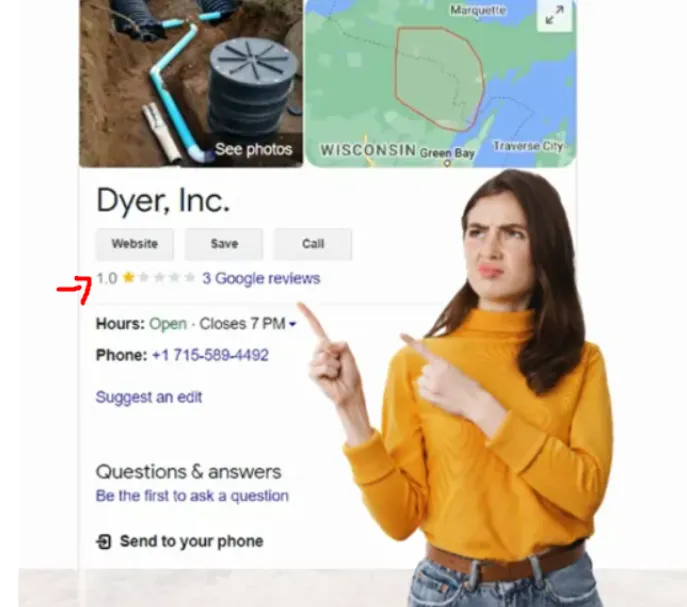
Google Maps and local business results help homeowners discover nearby companies. Your Google Business Profile is the business information they can encounter there, including your name, phone number, services, hours, photos, and reviews.
The homeowner does not always visit your website. They may read the listing and call directly. Someone looking for septic pumping could make a decision from the service information, reviews, and availability shown in that profile.
Google explains that local rankings are mainly based on relevance, distance, and prominence. Relevance concerns how well the business matches the search. Distance concerns its location relative to the searcher. Prominence concerns how well-known the business is, including signals such as reviews and websites linking to it.
That is why complete, accurate business information matters. It helps Google and the customer understand what your company actually does. It does not mean you can select a distant town as a service area and guarantee a top position there. Distance remains part of the equation.
Paying for Profile Work Is Not Buying an Organic Maps Position
A contractor can pay an agency to improve business information, organize photos, support an honest review-request process, and strengthen the company's local web presence. Those are services performed on your behalf.
They are not payments to Google for a guaranteed unpaid ranking. Google explicitly says businesses cannot request or pay for a better local ranking.
That distinction should change the questions you ask. “What work are you doing to improve our local presence?” is useful. “How much do I pay Google to put our normal listing first?” starts from the wrong assumption.
There is one important complication: Google also offers paid advertising placements in Maps. A location pin or a Maps screen does not automatically prove an interaction was organic. Paid placement and the ranking of an unpaid business listing are separate things, even when they appear in the same product.

Organic Search: Your Website Appearing Without an Ad Placement
Organic search refers to unpaid website results. Here, the homeowner chooses a link to a page rather than contacting a business directly from its listing.
For an excavation company, that might be a page about site preparation, foundation excavation, land clearing, grading, or drainage. For a septic company, it might be a page about new septic system installations, replacements, repairs, pumping, or inspections. The page should reflect services your company actually performs, not a list added only to attract searches.
The website must do more than repeat a town name and a service. It should explain the work, identify who it is suitable for, establish your real service area, and show credible examples. A homeowner should be able to decide whether your company belongs on their shortlist.
Search engine optimization, or SEO, is the work of making the site accessible, useful, and understandable to search engines and people. It does not mean purchasing an organic position. Visibility takes time and is not guaranteed, and not every visitor will be ready to book immediately.
Local SEO and Website SEO Are Related, Not Identical
A useful website and a complete Business Profile can support the same business without being the same asset. One is your local listing. The other is a collection of pages people can discover and visit.
An excavation contractor may have a well-established Maps presence near its office but weak pages explaining drainage work. Another company may have a detailed service page appearing in organic results without occupying the top unpaid Maps position for that searcher.
Your website can contribute to the broader information available about your company. Google also identifies links from other websites as one element of local prominence. But website visibility and local ranking still have distinct considerations.
When someone sells you “SEO,” ask what is included. Are they improving your Business Profile, your website, or both? What services and locations are they working on? A vague promise to “get you on Google” does not tell you which problem they are solving.
Google Search Ads: Paying to Compete for Sponsored Visibility
Google search ads are paid placements associated with searches. They are identified with advertising labels such as “Sponsored” and are distinct from the unpaid results.
A septic company might advertise new septic installations or system replacements to homeowners planning that work. An excavation contractor might advertise site preparation, land clearing, or driveway construction in the area its crew can serve profitably. The ad provides a route to visibility while the company is competing for that placement.
In a typical search campaign, the advertiser pays for clicks. Paying for a click does not purchase a completed job. Campaign settings, competition, the message, and the page the person visits all affect whether the opportunity is worthwhile.
Paid search can be useful when you want to promote a particular service or test demand in a defined area. It is not an unlimited supply of suitable homeowners. Broad searches, poor location settings, and a generic destination can create inquiries your office cannot use.
Buying Ads Does Not Improve Your Unpaid Rankings
This is the distinction many contractor conversations miss. Google says paid search investment does not improve organic search ranking. A company can buy advertising and still have weak unpaid website visibility.
The reverse is also possible. A business can appear in unpaid results without running a Google Ads campaign. Turning off ads removes that paid campaign's visibility; it does not automatically erase the company's organic website results or unpaid business listing.
That does not mean nothing else can change at the same time. Competition, search demand, website changes, and local ranking factors can affect unpaid visibility independently. The point is that advertising and organic ranking are not one purchased package controlled by an ad budget.
If a report says you are “first on Google,” ask whether that means a sponsored placement, a Maps listing, or an organic website result. Also ask which search and location were checked. A screenshot is not proof that every nearby homeowner sees the same thing.
Where Local Services Ads Belong in the Comparison
Local Services Ads are a separate paid Google product, not another name for standard Google search ads or your unpaid Maps listing. They can connect eligible businesses with people through calls and, where supported, messages.
Their lead-based billing differs from a typical pay-per-click search campaign. A billed lead still is not a guaranteed sale, and the business needs to answer and evaluate the inquiry.
Eligibility depends on the actual service category and location, with screening or verification requirements that can vary. Excavation and septic contractors should check their specific eligibility rather than assume every service is supported. Do not choose an inaccurate category just to access the product.
When reviewing a proposal, make sure “Google Ads” does not vaguely combine standard search campaigns and Local Services Ads. You need to know which product the provider intends to manage and what costs are involved.
Your Website Is a Destination, Not Always the Original Source
A homeowner can reach the same service page from a Google ad, an unpaid search result, or your Business Profile's website link. Someone who already received a referral can also search your name and arrive there.
That is why “the website brought us the job” sometimes describes only where the customer took action. It does not always explain what introduced the business or prompted the visit.
Your website still has an important job in every scenario. It should confirm that you perform the requested work, show proof, explain the next step, and make contacting the office easy. A septic installation or excavation ad that opens a generic homepage makes the homeowner search again inside your site.
Match the destination to the promise. A septic installation prospect should find information about installations, relevant project examples, and how to request an assessment. Someone planning a new home should see the site preparation or foundation excavation services you provide. A homeowner asking about driveway washouts should see relevant driveway and drainage work, not a page that leaves them guessing whether you handle the problem.
Choose the Fix That Matches the Visibility Problem
If your Business Profile is incomplete or inaccurate, work on the local listing. If your website barely explains the services you want to sell, improve those pages. If you need paid visibility for a defined service, evaluate a suitable advertising campaign.
These decisions are different from automatically purchasing every marketing service. Start with the actual gap. A busy pumping route does not need the same promotion as a company trying to book more replacement estimates. A grading crew with a strong backlog may need future project inquiries rather than more immediate repair calls.
When local demand exists but homeowners do not understand your services, clearer information and proof can help. When you want sponsored visibility now, ads may be appropriate. Neither option removes the need for prompt answers and a realistic plan for delivering the work.
Ask Your Marketing Provider to Name the Product
Before approving a proposal, ask whether the work covers your Google Business Profile, organic website visibility, standard Google search ads, or eligible Local Services Ads. Ask what is being improved, what advertising spend is separate from management fees, and where homeowners will go after clicking.
Have the provider show the difference using your own listing, website, and campaigns rather than a generic screenshot. Keep account access clear so you can see the assets your company depends on.
A plain-language explanation should leave you understanding what you own, what work is being performed, and what visibility depends on ongoing advertising spend. If everything is described as “Google leads,” you still do not have enough information to judge the proposal.
You do not need to become a Google specialist to make a better marketing decision. You need to know the difference between your local business listing, your unpaid website results, and the advertising placements you purchase. Send us a message today to find out how Excavation Marketing Pros can help excavation and septic contractors identify the right visibility gaps and build a clearer plan for bringing in the work they actually want.











Facebook
Instagram
X
LinkedIn
Youtube
TikTok