





Your crews are busy. The phone is ringing. You have more work on the calendar than you did last year. Then payroll comes around, a supplier invoice lands, and you are checking the bank account more often than you want to admit.
How can a company be growing and still feel short on cash?
For excavation and septic contractors, the answer often comes down to timing. You pay to prepare for the job, perform the work, and keep the company running. The customer's money may arrive later. When several projects overlap, that gap can grow faster than your sales.
But timing is not the only possibility. Weak pricing, unbilled extra work, slow collections, and equipment commitments can create the same pressure. The goal is to find the cause, not assume another booked job will fix it.
You do not need a more impressive revenue number. You need profitable work that turns into collected cash on a schedule your business can support.
Revenue, Profit, and Cash Are Not the Same Number
Revenue tells you how much business you have earned under your accounting method. Profit tells you what remains after the relevant costs. Cash tells you what money has actually moved into and out of the business.
A signed estimate is future work, not automatically earned revenue. An invoice is a request for payment, not proof that the money has arrived. If your books use accrual accounting, completed work can contribute to reported revenue before the customer pays. Your accountant can explain how your accounting method affects the reports you see.
That distinction matters when an owner looks at a healthy profit report and assumes the same amount should be sitting in the checking account. Equipment purchases, loan repayments, unpaid invoices, and owner distributions can all affect that comparison.
The FDIC's small-business financial guidance separates profit reporting from cash movements for this reason. Review both. Neither one replaces the other.
Growth Can Make the Payment Gap Bigger
Imagine a hypothetical septic installation or excavation project priced at $30,000, with estimated direct job costs of $22,000. That leaves $8,000 in estimated gross profit before overhead. It is not $8,000 in net profit, and the final result still depends on actual costs.
Now suppose you have collected $6,000 under the project's lawful payment arrangement, but $14,000 in job-related bills must be paid before the next customer payment arrives. That creates an $8,000 temporary cash gap before considering other available funds or company overhead.
The job can look attractive on the estimate and still require cash to carry it. Those figures illustrate timing, not a recommended deposit or payment schedule.
Repeat that situation across several overlapping jobs and the pressure multiplies. Another project may add future gross profit while increasing this week's cash requirement. That is why growth needs a funding plan, not just a sales target.

Put Payment Terms in the Job Before the Crew Goes Out
For a septic replacement, you may need components, excavation, hauling, inspections, and subcontracted work. For a driveway or site-preparation project, aggregate deliveries and equipment mobilization may create substantial early costs. The payment plan should account for the work you must fund.
Set out the agreed payment events in writing before starting. Identify who receives invoices, when payment is due, what documentation is required, and how approved additional work will be billed. Where permitted, deposits and progress payments can reduce the amount your company must carry.
Do not copy a deposit percentage from another contractor and assume it is legal or suitable for your projects. Rules vary by state, contract, and type of work. For example, California's contractor guidance places specific limits on covered home-improvement down payments. Check the requirements where you operate.
A clear payment arrangement protects both sides. The homeowner understands what triggers a payment, and your office knows when to bill without improvising after the equipment arrives.
Stop Letting Completed Work Sit Unbilled
Sometimes the cash problem begins inside the office, not with a slow-paying customer.
The crew finishes a milestone on Tuesday. The paperwork reaches the office Friday. The invoice goes out the following week. Your company has added delay before the customer's payment clock even begins.
Give billing a defined handoff. The field team should submit completion notes, approved changes, quantities, or photos promptly. The office should issue the invoice when the contract allows and confirm it reached the correct person.
Routine septic service may allow payment at completion. Larger excavation projects may have a different approval process. Build the workflow around the actual contract rather than assuming every customer pays the same way.
Track work completed but not yet billed separately from invoices already sent. These are different problems, and each needs a named person responsible for moving it forward.
Give Unpaid Invoices an Owner
“We sent the invoice” is not the end of the collection process.
Someone should review unpaid balances each week, confirm due dates, identify missing approvals, and follow up professionally. A disputed charge, wrong billing contact, or missing purchase-order number needs a different response from a customer who simply forgot to pay.
Review which balances are current and which are overdue. Record promised payment dates, then compare those promises with actual deposits. Do not forecast a disputed invoice as certain cash arriving Friday just because that would make payroll easier.
A courteous reminder with a clear payment method is often more useful than a vague message asking whether the customer has seen the bill. Your team should follow documented terms and any applicable collection requirements, not invent threats when a balance is late.
Bigger Jobs Need Better Control of Extra Work
You priced one scope. The homeowner adds drainage work. The crew removes additional unsuitable material. A second hauling trip becomes necessary. Everyone agrees verbally, but the extra work never becomes a clear, approved charge.
Now your company has paid the additional labor, fuel, and disposal costs while the invoice still reflects the original job.
Use written change orders for agreed additions before performing them whenever practical and required. For genuinely unexpected conditions, follow the notice and authorization process in your contract. Document what changed, its price, and any payment or schedule effect.
This is not about charging customers for every minor inconvenience. It is about avoiding substantial unpaid work that quietly consumes both margin and cash. A collection process cannot recover revenue you never properly agreed to bill.
Your Equipment Payment Is Only Part of the Commitment
A busy calendar can make another truck or machine look like an obvious purchase. Look beyond the monthly payment.
A septic truck brings insurance, maintenance, staffing, fuel, and operating costs. An excavator may require transport, attachments, storage, and repair reserves. A down payment can reduce cash immediately, even before the added equipment produces collected revenue.
Loan principal repayments use cash without being treated like ordinary operating expenses on the profit-and-loss statement. Interest and other costs are accounted for differently. Your accountant should help you reconcile the details, rather than treating the loan statement as a complete picture of profitability.
Before adding capacity, forecast what happens if the new asset works fewer paid hours than expected or customer collections take longer. Ownership should support a reliable workload, not force you to accept weak jobs to cover a payment.
Build a Weekly Cash Forecast You Can Actually Use
A practical starting point is a rolling 13-week forecast. That is a planning horizon, not an industry rule or a guarantee that you can predict every expense.
Start with available business cash. For each week, enter realistic customer collections and the payments you expect to make. Include payroll, suppliers, subcontractors, disposal, insurance, debt payments, taxes, equipment purchases, and planned owner distributions where applicable.
Keep new borrowing separate from customer receipts. Loan proceeds can increase cash, but they are not sales or operating profit. Keep uncertain prospects separate from contracted work and collectible invoices.
Update the forecast weekly with actual results. Ask what happens if a major payment arrives late, weather delays a project, or a truck needs repair. The FDIC's cash-flow management guidance emphasizes projections, seasonal planning, organized records, and reserves rather than relying on the current bank balance alone.
Set a Cash Buffer Around Your Actual Obligations
There is no single reserve amount that fits every contractor. A company collecting routine pumping payments quickly has a different cash cycle from an excavation company carrying substantial project costs before progress payments arrive.
Work with your bookkeeper or accountant to identify the obligations you must cover, your collection pattern, seasonal exposure, and the costs of a realistic disruption. Use that information to set a cash floor and an action plan for approaching it.
Review owner withdrawals against upcoming commitments, not just today's balance. Likewise, do not treat an incoming customer advance as money freely available for unrelated spending. The project still needs to be completed, and customer-fund rules may apply.
If deposits from new jobs repeatedly keep older jobs afloat, investigate promptly. More sales can hide a pricing, production, or collection problem without correcting it.
Make Marketing Support the Cash Plan
The answer is not automatically to turn off marketing. But it is also not to advertise every service harder while the business struggles to fund the work already sold.
Compare services by gross profit, cash needed before collection, payment speed, crew capacity, and seasonality. A well-routed septic pumping job might collect sooner than a large installation, while a properly structured installation can still be excellent business. Neither service wins simply because of its invoice size.
For excavation contractors, a driveway repair, a bundled drainage project, and a builder's site-preparation contract can have different funding needs and payment cycles. Market the mix your company can deliver profitably and carry responsibly.
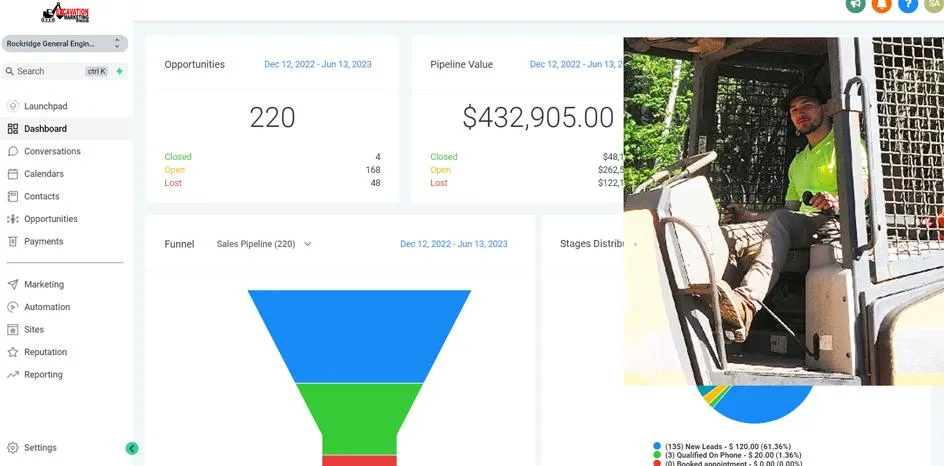
Connect the lead record to the estimate, completed job, invoice, and payment. Your CRM can track the sales process and handoffs, while your accounting system verifies collections and costs. A dashboard full of leads cannot tell you whether the resulting work strengthens your cash position.
Grow a Company That Can Afford Its Growth
A fuller calendar should improve the business, not leave the owner guessing which payment will cover the next obligation.
Start by checking the gap between completed work, billing, and collection. Then review payment arrangements, extra work, equipment commitments, and the cash needed for overlapping projects. If the business is losing money rather than simply waiting for payment, address the underlying economics with your accountant.
Excavation Marketing Pros helps excavation and septic contractors build marketing and follow-up systems around better-fit opportunities and measurable results. Your accountant manages the financial reporting. Your marketing system should help you understand which opportunities become completed, collected work.
Send us a message today to find out how Excavation Marketing Pros can help you attract the right jobs, strengthen follow-up, and build a pipeline that supports sustainable growth.










Facebook
Instagram
X
LinkedIn
Youtube
TikTok