

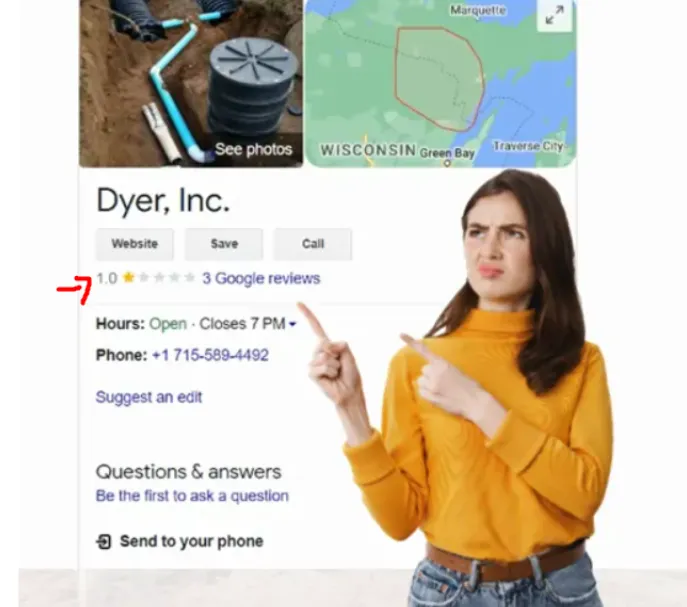


A negative Google review can feel personal when you own a septic company.
You may remember the job. You may know the crew worked hard. You may believe the customer is leaving out details about access, permits, changing site conditions, an inspection result, or the work they approved. And when the review appears beside years of good work, it is easy to want it gone immediately.
But a negative review does not automatically mean your reputation is damaged. For established septic contractors, the bigger issue is what the review reveals about the customer experience and how the company responds in public. A calm, professional response can show future homeowners that your business takes responsibility, communicates clearly, and does not disappear when a project becomes difficult.
The goal is not to win an argument in the reviews section. The goal is to protect trust, solve real concerns, and make sure one unhappy experience does not define a company that has served its community well.
Do Not Respond While You Are Still Angry
The first response is usually the most important one because it is the one future customers will read. That is why no one should reply while frustrated, defensive, or trying to prove the customer wrong.
A septic issue is often stressful before your company even arrives. A homeowner may be worried about sewage backing up, a failed inspection, a delayed real-estate closing, a damaged yard, a surprise repair cost, or a system replacement they did not budget for. Even when the work was completed properly, that stress can show up in the review.
Pause long enough to understand what happened. Ask the office and crew for the job history. Review the estimate, change orders, inspection notes, photos, call recordings if your company keeps them, payment history, and every message sent to the customer. You are looking for facts, not ammunition.
Sometimes the review identifies a problem worth fixing. Maybe the office did not explain the schedule clearly. Maybe a customer expected restoration to happen sooner. Maybe the crew did excellent technical work but the homeowner did not understand the next step. Those gaps are valuable because they show where your operation can become easier to work with.
First Decide What Kind of Review You Are Looking At
Not every negative review should be handled the same way. A real customer with a legitimate concern needs a thoughtful response and an attempt to resolve the issue. A mistaken review may require a polite request for more information. A review from someone who never had a real experience with your business may need to be reported through Google’s process.
Google says that businesses can report reviews, but a review is eligible for removal only when it violates Google policies. Google also makes clear that businesses should not report a review simply because they dislike it or disagree with it. Negative feedback can be a real customer-service signal, even when it is uncomfortable to read. [1]
That distinction matters. Do not treat the reporting button as a way to erase every critical comment. Use it when there is a genuine policy issue, such as content that appears fake or misleading, off-topic, threatening, personally identifying, repetitive, or otherwise prohibited. Google’s content-policy categories include fake and misleading content, harassment, personal information, profanity, off-topic material, advertising, and repetitive content. [2]
If the reviewer is real and the complaint is about their experience, your strongest option is usually not removal. It is a clear response and a real effort to address what went wrong.
Investigate the Job Before You Write a Public Reply
A good response starts inside the business.
Create a simple review-triage process. When a negative review appears, the office should identify the property, job type, estimate amount, crew, job dates, and the customer’s last contact with the company. The owner or manager should then decide whether the review describes a valid service concern, a misunderstanding, an unresolved billing or scope question, or a possible policy violation.
This process prevents a common mistake: responding from memory. Memory is rarely complete on a technical project. The company may remember that a homeowner approved a repair, but the written scope may show a detail that was not fully explained. The homeowner may remember a promised date, while the office notes show that weather or permit timing changed the schedule. Facts help you respond fairly and keep the review from turning into a public dispute.
For septic contractors, the job record should show more than the invoice. It should include the original complaint, findings, recommended scope, approvals, photos where appropriate, key timing conversations, and what the customer was told about restoration, inspections, warranties, or follow-up. When that information is organized in a CRM or job-management system, a negative review becomes easier to investigate and easier to resolve.

Write for the Next Homeowner, Not Just the Reviewer
Your reply is public. The reviewer will read it, but so will the homeowner who searches for “septic repair near me” next month.
That future homeowner is not looking for a perfect company with no difficult jobs. They are looking for a company that appears trustworthy when something becomes complicated. A short, calm response can communicate far more than a long explanation ever will.
Start by acknowledging the concern without admitting facts you have not verified. Thank the person for the feedback. State that the company takes the experience seriously. Invite them to continue the conversation directly by phone or email. If you know a manager’s direct line, provide a simple path to reach the right person.
Avoid using the review reply to explain every detail of the project. Do not publish a customer’s address, invoice amount, service history, inspection findings, phone number, or other private information. Do not accuse the reviewer of lying. Do not argue about who remembers the job correctly. And do not use a defensive reply to win a point that only makes future customers uncomfortable.
A better public reply sounds like this:
Thank you for sharing your feedback. We are sorry to hear that the experience did not meet expectations. Our team would like the chance to review the project details and speak with you directly. Please call our office at [phone number] or email [email address] so we can work toward a resolution.
That response is not weak. It is controlled. It tells the public that your company is available, professional, and willing to investigate.
Move the Resolution Offline, Then Close the Loop
The public reply should open a door. The real resolution should happen privately.
When you contact the homeowner, listen first. They may be upset about cost, timing, damage concerns, communication, or an outcome they do not understand. Ask what they expected, what they believe went wrong, and what information they still need. Then compare that concern with the job record.
If the company made a mistake, correct it quickly and clearly. A delayed callback, an unclear explanation, a missed expectation, or a preventable communication gap should become an operational lesson. If the work needs a return visit, schedule it. If the concern is about a technical issue, make sure the right person explains the finding in plain language. If there is a dispute that cannot be resolved by the office, use your normal professional or legal process privately rather than debating the situation on Google.
After a real resolution, it is reasonable to let the customer know that you are glad the issue was addressed. Do not pressure anyone to change or remove a review. The purpose of the conversation is to fix the experience, not to manufacture a better rating.
When Reporting a Review Is the Right Move
A review should be reported when it appears to violate Google’s rules, not when it is merely unpleasant.
For example, a review may warrant a report if it comes from someone with no apparent connection to the company, promotes another business, contains threats or hateful language, shares personal information, or looks like part of a fake or repetitive pattern. Save screenshots and job-history notes before reporting it so your team can keep a clean record of what it reviewed.
Google says review reports are typically evaluated over several days. The Reviews Management Tool can be used to check the status. If Google concludes that there is no policy violation, an eligible business can submit a one-time appeal. [1]
Do not build your reputation plan around getting reviews removed. Even a review that feels unfair may remain if it does not violate the rules. Your company needs a response process that works whether Google removes it or not.
Do Not Try to Bury a Bad Review With Bad Review Practices
After a negative review, it is tempting to ask only your happiest customers for five-star reviews immediately. That can create a new problem if the company becomes inconsistent or manipulative in how it asks for feedback.
The better approach is a steady review-request process after completed jobs. Ask customers for an honest review after pumping, repairs, inspections, septic installations, site prep, or excavation work when the project is complete and the customer understands what was done. Make the request easy. Use a simple follow-up text or email. Let the work and the customer experience do the talking.
A consistent flow of real reviews helps future customers see the full picture. It does not erase a bad review, and it should not. It places the occasional difficult experience in the context of the company’s broader record of service.
For many septic contractors, the best protection against one negative review is not a clever reply. It is an operating system that reliably produces clear communication, completed work, real proof, and honest feedback from customers every month.
Turn Review Patterns Into Better Operations
One review may be unusual. Three reviews that mention the same problem are a pattern.
If multiple customers mention slow callbacks, unclear estimates, surprise costs, restoration delays, or poor follow-up, the business has useful data. The issue may not be marketing at all. It may be a handoff between the office and field team, a gap in estimate language, a scheduling policy, or an incomplete closeout process.
Review feedback should be discussed in regular team meetings. Not to embarrass a crew member or office employee, but to identify what should change. Can the office set better expectations when a customer calls? Can the estimator explain project variables before the job begins? Can the crew give the homeowner a clearer end-of-day update? Can the CRM prompt a follow-up call after a major repair or installation?
This is where reputation management becomes business improvement. The same systems that reduce preventable complaints also improve reviews, referrals, close rates, and repeat revenue.
Give Your Team a Simple Response Standard
Your team does not need a complex reputation-management manual to handle negative feedback well. It needs a clear standard.
The office should know who monitors reviews, how quickly a manager should be notified, where job facts are stored, who is authorized to write public responses, and how unresolved concerns move from a review to a real conversation. The team should understand that public replies are respectful, brief, and private-information free. It should also know when a review can be reported and when it should simply be answered professionally.
This standard protects the owner from reacting emotionally after a long day. It protects employees from being pulled into a public argument. Most importantly, it protects the company’s reputation by showing homeowners that the business handles problems with the same care it brings to the work itself.
A Negative Review Can Become a Trust Signal
A perfect five-star profile with no context can look less credible than a strong profile with an occasional complaint handled well.
Future customers know septic work is not always simple. They understand that weather, site conditions, permits, inspections, and unexpected system failures can complicate a project. What they want to know is whether your company communicates, follows through, and stays accountable when it matters.
That is why a negative review should be treated as a management moment, not a panic moment. Investigate the facts. Respond with professionalism. Resolve what can be resolved. Report only genuine policy violations. Then use what you learn to make the next customer experience better.
For septic and excavation contractors, reputation is not built by avoiding every problem. It is built by showing customers how your company responds when a problem appears.
Send us a message today to find out how Excavation Marketing Pros can help your septic company strengthen its reviews, improve local trust, build better follow-up systems, and turn your reputation into a dependable source of qualified leads.













Facebook
Instagram
X
LinkedIn
Youtube
TikTok