



A septic company can be busy and still have a marketing problem.
That sounds backward at first. The phone may be ringing. The crews may be booked for a few weeks. Referrals may still be coming in. But if the owner cannot explain where the best jobs come from, why certain months are strong while others are quiet, or what happens after a lead calls, the business is depending on momentum rather than a repeatable system.
For an established septic company, better marketing is not about getting as many leads as possible. It is about creating a predictable flow of the right homeowners and property owners, responding quickly, turning more estimates into booked work, and understanding which efforts are producing a real return. The company should be able to grow without chasing every inquiry, discounting every quote, or waiting for the next referral to rescue a slow calendar.
Here are the signs that it may be time to improve the marketing strategy behind your septic business.
Your Calendar Moves From Packed to Empty Too Quickly
A healthy septic business has seasons, weather delays, and changes in service demand. Those are normal. The warning sign is when the calendar repeatedly moves from overloaded to empty with no visibility into why.
That pattern often means the company is reacting to demand instead of planning for it. Marketing gets turned off when the crews are busy, then turned back on only after the backlog starts to disappear. Reviews, website updates, follow-up, local visibility, and advertising become inconsistent. By the time the owner notices the next gap, homeowners who were researching weeks earlier have already found another company.
A better strategy keeps future demand moving even during a busy period. It may adjust budget, target services, or scheduling language, but it does not disappear. The goal is to maintain a pipeline of qualified opportunities for the work you will want thirty, sixty, or ninety days from now.
You Get Calls, But Too Many Are the Wrong Fit
More calls do not always mean better marketing. A septic company can receive plenty of inquiries and still waste time on people outside the service area, price shoppers who were never a fit, projects the crew does not want, or work that does not support the company’s margin and capacity.
If the office is constantly sorting through poor-fit leads, the marketing message may be too broad. Your website, Google Business Profile, ads, and service pages should make it clear what your company does, where you work, and how the process begins. A customer who needs pumping, a drain field repair, a septic system replacement, an inspection, or a new installation should understand whether your company is the right fit before they call.
Better marketing does not eliminate every unqualified inquiry. It helps your company attract more of the work you can serve well. For some septic contractors, that means focusing on repairs and replacements in a defined area. For others, it means building more repeat pumping and inspection demand, or creating a better path from a service call to a future installation conversation.
Your Best Services Are Not the Ones Getting Promoted
Many companies market every service with the same energy because they can perform every service. That approach can produce activity, but it does not always support the business the owner wants to build.
Look at the services that create real value. Which jobs have strong margins after labor, equipment, materials, disposal, and travel are counted? Which services close well? Which ones fit the crew and equipment you have today? Which services create reviews, referrals, repeat revenue, or opportunities for future work?
The answers should influence the marketing strategy. If a profitable septic replacement service is under-promoted while the company spends most of its time chasing low-value calls, the marketing system is pulling the business in the wrong direction. If pumping and inspections are a reliable source of repeat revenue and repair opportunities, they deserve a clear plan for reminders, reviews, and follow-up.
A good marketing strategy helps the owner steer demand. It should not leave the company taking whatever appears first.
You Cannot Identify Where Your Best Jobs Came From
If the team cannot tell whether a booked septic replacement came from Google, a review, a referral, a paid ad, the website, a past customer, or a local partner, it is difficult to make confident marketing decisions.
This does not require a complicated reporting department. It requires a disciplined intake process. Every new inquiry should be asked how they found the company. That source should be recorded in the CRM or job-management system. When an estimate is approved, the company should be able to connect the completed work back to the source that brought the lead in.
Without that information, owners tend to make decisions based on the loudest recent story. A single expensive ad may feel successful because it generated calls, while a quieter source such as Google Business Profile reviews or past-customer reminders may be producing better jobs at a lower cost. Tracking turns opinions into evidence.
The most useful question is not, “Which channel gave us the most leads?” It is, “Which channel produced the most profitable booked work?”

Leads Wait Too Long for a Response
A strong marketing system includes what happens after the phone rings. It does not end with an ad, a website form, or a Google Business Profile listing.
Homeowners with septic issues are often concerned, confused, and ready to talk to the first professional company that responds clearly. If a form sits for a day, a missed call is not returned promptly, or the office cannot explain what happens next, the business can lose an opportunity it already paid to create.
Fast response does not mean promising immediate onsite service when the schedule is full. It means acknowledging the customer, gathering the right information, explaining the next step, and setting a realistic expectation. A quick call, text, or email can protect the opportunity while the team coordinates an inspection, estimate, pumping route, repair visit, or future opening.
If your marketing brings in leads but your follow-up is inconsistent, you do not necessarily need more advertising. You may need a better intake and follow-up process first.
Your Website Makes Homeowners Work Too Hard
When someone lands on your website, they should not have to hunt for the basics. They should quickly understand what services you offer, the areas you serve, what makes your company credible, and how to request help.
A confusing site quietly sends good prospects away. A homeowner may be looking for drain field repair but see only a vague list of services. They may need a septic system replacement but find no explanation of the process. They may wonder whether you serve their town, whether you work with homeowners, or whether anyone will call them back. If those answers are not easy to find, the customer will often return to Google and choose another option.
A better marketing strategy starts with clarity. Create useful pages for the core services you want to grow. Show real job photos, recent reviews, service areas, and a simple way to contact the company. Your website should make the next step feel obvious, not like a research project.
Your Reviews and Project Proof Are Not Growing
The jobs your company completes today should make tomorrow’s marketing stronger. If customers are happy but reviews are not being requested, job photos are not being saved, and before-and-after proof is never used, the company is leaving valuable credibility on the table.
Reviews help local homeowners trust you before they call. They support your visibility in local search. Real project photos make technical work easier to understand and show that your crew performs the work it claims to perform. A short customer story can give a future homeowner confidence that your company communicates well during a stressful project.
This does not need to be a complicated content plan. Build a simple closeout habit. Ask for a review after a successful job. Capture a few usable photos. Note the service type and the town. Add the best proof to your Google Business Profile, service pages, proposals, and social content over time.
A marketing strategy becomes more efficient when the work itself produces trust assets that can be used again and again.
You Are Trying Tactics Without a Clear Plan
Google Ads, Facebook ads, Local Services Ads, SEO, social posts, email reminders, referral programs, and website updates can all have a role. The problem comes when a company tries a new tactic every month without deciding what job the tactic is supposed to do.
One campaign may be designed to capture an urgent repair need. Another may be intended to keep the company visible to homeowners who will need a system replacement later. A review system may be designed to build trust and local authority. A past-customer reminder may be designed to create repeat pumping or inspection work. These are different goals, so they should not be measured the same way.
A better strategy starts with priorities. Decide which services matter most, which areas you want to serve, how quickly the office can respond, what the crew can handle, and what a profitable result looks like. Then choose the marketing activity that supports those goals. Consistency is more useful than constantly starting over.
Marketing Feels Like an Expense Instead of a Measurable Investment
When the owner cannot see the connection between marketing and booked work, marketing naturally feels like a cost that should be cut. That is understandable. No established business wants to keep spending money because someone says it might help.
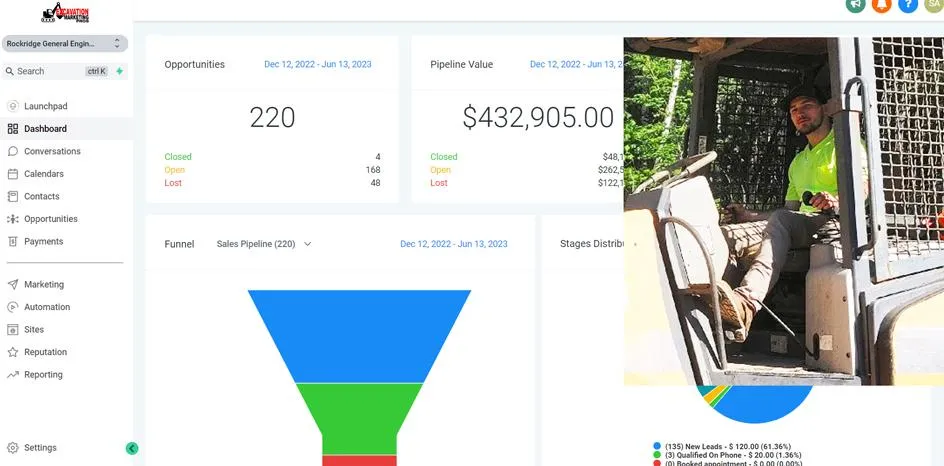
The answer is not blind faith. The answer is measurement. Track leads, estimates, close rates, job value, and revenue by source whenever possible. Compare the cost of a campaign to the gross profit from the work it actually produces. Review which service lines are being promoted and whether the company has the capacity to deliver them well.
Not every action will produce the same return, and not every marketing channel needs to work immediately. But the owner should be able to see enough evidence to decide what deserves more investment, what needs improvement, and what should be stopped.
For septic contractors, a good strategy makes marketing easier to manage because it replaces guessing with a clearer view of the numbers.
The Right Strategy Connects Visibility, Follow-Up, and Operations
The strongest septic marketing system is not just a website or an ad campaign. It connects local visibility, reputation, lead intake, estimate follow-up, job capacity, and reporting.
A homeowner sees your company in local search or through a referral. They find a useful service page and recent reviews. They contact the office and receive a fast, professional response. The team understands their need, schedules the appropriate next step, follows up on the estimate, and records the outcome. The owner can then see which source produced the job and whether the work was worth pursuing.
That is a system. It is also the difference between hoping the phone rings and building a company that can make better decisions about future growth.
Send us a message today to find out how Excavation Marketing Pros can help your septic company improve local visibility, attract better-fit leads, build a faster follow-up process, and measure the return from every marketing dollar.













Facebook
Instagram
X
LinkedIn
Youtube
TikTok