




A septic company can have a month full of phone calls and still not have enough good work on the schedule. That is why lead count alone is a weak scorecard. Ten inquiries about a low-value service outside your area do not carry the same value as one replacement project, a profitable repair, or a route of pumping customers who are ready to book.
The question an established septic owner needs answered is not, “Which channel gave us the most leads?” The better question is, “Which marketing channels are actually bringing us qualified opportunities, sold jobs, and revenue?” That answer gives you a basis for deciding where to invest, what to fix, and which activity is just keeping the office busy.
For a septic company with a real local reputation, tracking should not become a second job. It should become a simple operating habit. Your office, CRM, call process, and estimates should preserve the story of each opportunity from the first click or phone call through the final invoice. When that story is intact, marketing decisions become less emotional and much more profitable.
Why Lead Source Tracking Matters for Septic Companies
Without source tracking, owners tend to make decisions from the loudest signal. A salesperson says Google Ads are expensive. Someone sees a Facebook post get attention. A crew member says referrals feel slower. The response is often to increase, cut, or change spend based on incomplete information.
That creates two problems. First, a channel can look expensive at the lead level but produce the highest-value replacement, repair, or excavation work. Second, a cheap source can look successful because it produces many calls while generating few estimates that fit your crews, travel radius, or minimum job size.
A useful tracking system lets you compare channels at the same finish line. Did the inquiry become a qualified opportunity? Did it receive an estimate? Did the customer approve the work? What was the job value? What did it cost to acquire that job? Those are the numbers that help septic and excavation contractors protect margin while building a steadier pipeline.
The Problem With “How Did You Hear About Us?”
Asking every caller how they found you is still worth doing. It is quick, human, and often reveals information a report cannot. A customer may say they saw a truck, heard your name from a neighbor, searched Google, and then read reviews. That is useful context.
But it is not enough by itself. People do not always remember the first touchpoint. Some say “Google” when they clicked a paid ad. Others say “a friend” when the referral only motivated them to search your company name online. If the office has no consistent way to record the answer, the data becomes even less reliable.
Use the question as a confirmation, not the whole system. Your forms, call tracking, landing pages, ad accounts, and CRM should capture what they can automatically. Then the office should select or confirm a simple lead-source field while the conversation is fresh. The goal is not perfect attribution. The goal is reliable enough information to make better decisions every month.

Which Marketing Sources Should Be Tracked
Start with the sources that can realistically drive work to your company. For most established septic businesses, that includes Google Ads, Google Business Profile and Google Maps, Local Services Ads, organic website traffic, Facebook and Instagram ads, social posts, referrals, repeat customers, yard signs or trucks, and local partner referrals.
Do not create a source list with fifty choices. If an office coordinator has to think for two minutes about which label to select, the system will fail. Use plain categories that match how you make marketing decisions. “Google Ads,” “Google Maps,” “LSA,” “Facebook or Instagram,” “Referral,” “Repeat Customer,” and “Other” are enough to begin. You can add useful detail later, such as campaign, town, service type, or the exact referral partner.
Every category should lead somewhere. If you separate Google Maps from organic website traffic, do it because you want to know whether Maps visibility is producing more profitable calls than your content or service pages. If you label a lead “Facebook,” be clear whether it came from a paid campaign, a direct message, or an organic post.
Track Google Ads Beyond the Form Fill
Google Ads can report valuable actions that happen on your website or through phone calls, but your business still needs to decide which action has real value. A request form, a click-to-call, and a long phone conversation are not equal. A septic company should track the first contact, then connect that contact to qualification, estimate, booked job, and revenue in the CRM.
When a prospect clicks an ad, preserve the campaign information when possible. A dedicated landing page, correctly configured conversion tracking, a call tracking number, and a CRM source field give you a cleaner record of the journey. If your team marks every quote as “Google Ads” without recording which campaign or service the customer wanted, you will have only half the answer.
The useful conversation each month is not whether the campaign generated forms. It is whether the paid traffic created profitable pumping routes, repair work, inspections, system replacements, or excavation projects that matched your target job mix. That is the difference between reporting activity and managing an investment.
Separate Google Maps From Other Google Traffic
Google Business Profile and Google Maps deserve their own source category because these homeowners are often actively searching for a local contractor. Your profile can show calls, website clicks, and other interactions, but that performance data is only the starting point. Your office still needs to connect the contact to the job outcome.
Use a clear source field for Google Maps or Google Business Profile. If you use a tracked website link or dedicated phone number, make sure the lead arrives in the CRM with that source already attached. When a caller says they found you on Google, the coordinator can confirm whether they mean a Maps listing, a paid result, or a normal website search.
This distinction matters. Google Maps may produce a different mix of work than ads. It might bring in more ready-now pumping calls and emergency repairs, while a service page or paid campaign may produce more planned replacements. You do not need one source to win every category. You need to understand what each source does best for your company.
Use Meta and Local Services Ads With a Clear Tracking Plan
Facebook and Instagram ads often create interest before a homeowner is ready to call. That does not make them useless. It means the tracking needs to preserve the campaign and the next step. Use consistent URL parameters on paid links, make the landing page or form easy to identify in your CRM, and keep the call to action focused on one service or offer.
A homeowner who clicks a drainage, septic inspection, or replacement campaign may not book that day. They may return later through a branded search, direct call, or retargeting ad. That is why the office needs the original source stored rather than overwritten every time the customer engages again.
Local Services Ads should also have their own source category. They can generate calls and messages that feel immediately valuable, but the same discipline applies. Record the job type, location, estimated value, outcome, and any reason the lead was not a fit. Otherwise, a stream of low-margin calls can disguise itself as a high-performing channel.
Call Tracking Turns Ringing Phones Into Useful Data
Phone calls remain central to septic marketing. A homeowner with a backup, failed system, inspection deadline, or urgent repair question often wants to talk to a real person. If the call is not recorded as a lead with a source, however, the connection between marketing and revenue disappears.
Call tracking does not have to mean a complicated call-center operation. It can mean using dedicated numbers for major paid campaigns, preserving the referral source in the CRM, and giving the office a short qualification script. The coordinator should capture the service requested, the town, the timeline, the job type, and whether the caller meets your basic fit criteria.
Fast response belongs in this process too. A source cannot prove its value if the office misses the call and the homeowner hires the next contractor. Track response time alongside the source. If Google Maps leads close poorly because calls go unanswered after 4:30, the marketing channel may not be the real problem.
Let Forms and UTM Parameters Carry Their Part of the Work
Website forms should do more than collect a name and phone number. They should pass useful source information into the CRM. At minimum, preserve the landing page, the first source category, and the campaign information when it exists. For paid campaigns, URL parameters can identify where the visitor came from and which campaign sent them.
Consistency matters more than technical complexity. Decide one naming system for campaign source, medium, campaign, and service. If one campaign is labeled “Google,” another is “G-Ads,” and a third is “PPC,” your reporting will create three separate answers for the same source. Establish the names once and keep them stable.
Do not expect a UTM parameter to solve every attribution question. A homeowner may use more than one device, come back later, or call without submitting a form. That is why form data, call tracking, coordinator notes, and CRM records work best together. Each signal fills a gap left by the others.
Your CRM Must Store the Entire Opportunity Story
A lead source field should be required in your CRM, but source alone is not the dashboard. Each record should show the requested service, service area, estimated job value, appointment or estimate status, sales result, booked revenue, and source. For a repeat customer, record both the original acquisition source and the current reason for contact when that matters.
The goal is a clean handoff between marketing, office staff, estimators, and crews. When the field technician completes the job, the invoice should be tied back to the same opportunity. If the record stops at “estimate sent,” the owner still cannot see which channels produce actual revenue.
A simple stage structure works well: new inquiry, qualified opportunity, estimate scheduled, estimate delivered, sold, lost, and completed job. The wording can match your existing CRM, but the stages should mean the same thing every time. A lead is not qualified because someone filled out a form. It is qualified when it fits the work, location, timeline, and budget range your company can serve profitably.
Track Qualified Opportunities, Not Just Raw Leads
The fastest way to make reporting misleading is to celebrate every lead equally. A call from outside the service area, a homeowner asking for a job below your minimum, or a prospect who wants work you do not perform should be recorded, but it should not be treated as a marketing win.
Measure the number of qualified opportunities each channel produces. Then measure the estimate rate, close rate, average job value, and revenue from those qualified opportunities. That tells you whether the issue is the channel, the offer, the office intake, the estimating process, or the sales follow-up.
For example, Facebook may send fewer leads but a high percentage of planned replacement opportunities. Google Ads may produce more calls but a lower qualification rate because the campaign is too broad. Referral leads may close well but lack enough volume to support growth. None of those outcomes are failures if you can see them clearly and act on them.
Follow the Money Through the Estimate and the Job
You do not need a complicated finance department to calculate the basics. Start with cost per lead, cost per qualified opportunity, cost per estimate, cost per sold customer, average sold job value, and collected revenue by source. Review those figures by service type when possible.
Cost per lead is your marketing spend divided by the leads attributed to a source. Cost per customer is the spend divided by sold jobs. Those numbers become more meaningful when paired with revenue and gross margin. A channel that costs more per lead can still be the better investment if it consistently produces larger, cleaner, more profitable work.
An owner should also look for delayed revenue. Some inspection, repair, or pumping calls turn into replacement work later. If the original source is lost when a lead is reopened, marketing gets no credit for the job it helped start. Keep the original source visible while also recording the later services that were sold.
The Common Mistakes That Hide Good Marketing Decisions
The most common mistake is counting inquiries without tracking outcomes. The next is letting every team member use a different source label. Another is treating a form fill, phone call, and booked estimate as the same conversion. Those errors create attractive reports that do not help an owner make a better decision.
Do not overwrite original source data just because a lead calls again, replies to a text, or clicks another page. Do not put every caller into the same “Google” bucket. Do not ignore lost reasons. A lost estimate marked “price” tells you much less than one marked “out of area,” “no response,” “service not offered,” or “chose lower bid.”
Finally, do not wait for perfect tracking before using the information. Start with the sources, job outcomes, and sales stages you can record consistently. After two or three months, the patterns will be more useful than a perfect-looking spreadsheet with missing job results.
Build a Dashboard Your Team Will Actually Use
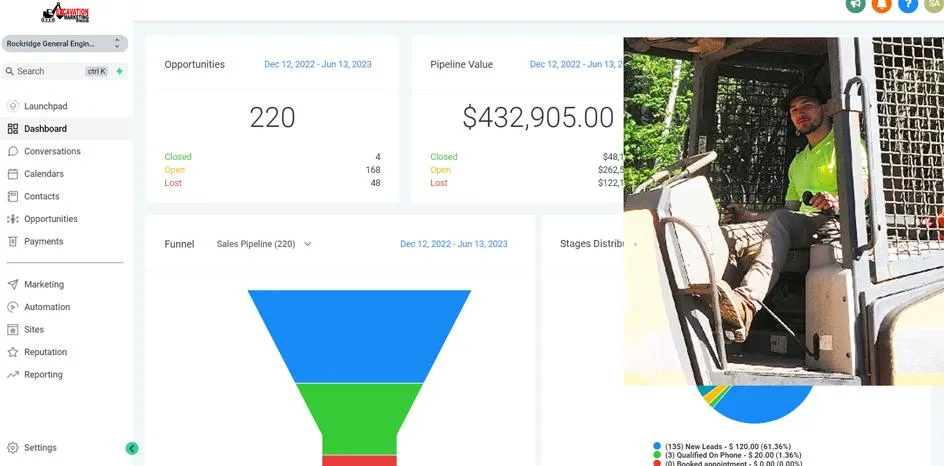
The best marketing dashboard is not the one with the most charts. It is the one your team reviews every month. Keep it focused on the questions that lead to a decision: Which channel produced the most qualified opportunities? Which source produced the highest sold revenue? Which services are each source bringing in? Where are leads being lost? Which campaigns should be improved, reduced, or given more budget?
Review the dashboard with your office and sales team at the same time each month. Compare the current period to the prior month and to the same season last year when possible. Ask whether a change in results came from demand, visibility, response time, qualification, estimating, follow-up, pricing, or job capacity. That conversation is far more valuable than arguing about which channel “feels” busy.
Your marketing should be judged by the work it helps your company win, not by how many names it deposits in a spreadsheet. When your septic company can trace a source through qualified opportunity, estimate, sold job, and collected revenue, you can invest with more confidence and stop funding marketing that does not fit your goals. Send us a message today to find out how Excavation Marketing Pros can help your septic company build a marketing and CRM tracking system that turns activity into clear, profitable decisions.














Facebook
Instagram
X
LinkedIn
Youtube
TikTok