
Get Ready To Sell More HIGH-VALUE Demolition Services
How To Track a Septic Lead From First Call to Paid Invoice
You know the call.
A homeowner is stressed. Their toilets are backing up. Their yard smells bad. Their tank alarm is going off. Or maybe they just bought land and need a septic install estimate before they can move forward.
Your office answers the phone. Someone writes down the name. Maybe it goes into the CRM. Maybe it goes on a sticky note. Maybe it gets texted to the owner. Maybe your dispatcher knows exactly what to do because they’ve been doing this for 15 years.
Then the day gets busy.
A truck breaks down. A tech calls with a question. A customer wants to reschedule. The county needs paperwork. Someone needs a quote. Someone else wants to know why you are not there yet.
By the end of the month, your marketing report says you got 86 calls.
Great.
But now you’re asking the question that actually matters:
How many of those calls turned into paid jobs?
That is where most septic companies get stuck.
You are not trying to win an award for “most website clicks.” You are trying to keep crews busy, book profitable jobs, sell more installs, reduce wasted ad spend, and stop guessing which marketing source deserves more money.
At Excavation Marketing Pros, we work with septic and excavation companies that live in this exact gap. They get calls. They get forms. They get Google leads. They have office staff, trucks, crews, service areas, equipment, and real overhead.
But they do not always have a clean way to connect the first phone call to the final paid invoice.
That is the gap we help septic companies close.
Below is a simple way to track a septic lead from first call to paid invoice, without making your team hate the CRM.
Here is The Septic Installer Growth Briefing:
Why Septic Companies Struggle To Know Which Leads Actually Make Money
Septic businesses are not simple from a tracking standpoint.
One lead could be a basic pumping job. Another could be a septic repair. Another could be a full install worth tens of thousands of dollars. Another could be a builder relationship that sends work for years.
But in many marketing reports, all those leads get counted the same.
That creates bad decisions.
For example, one campaign may bring 50 pumping calls. Another campaign may bring 8 install leads. The first campaign looks better if you only count lead volume. But the second campaign may produce far more revenue.
This is why septic lead tracking has to go past the first call.
You need to know:
Where the lead came from
What service they needed
Whether the call was answered
Whether the job was booked
Whether an estimate was sent
Whether the estimate closed
Whether the invoice was paid
How much revenue came from the original source
That is the whole game.
Not clicks.
Not “traffic is up.”
Not “your visibility improved.”
Those things can matter, but only if they lead to booked and paid work.
What Lead Tracking Should Mean for a Septic Business
Lead tracking should not be complicated.
For a septic company, lead tracking means you can follow a customer from the first moment they contact you to the moment money hits the business.
Here is the basic chain:
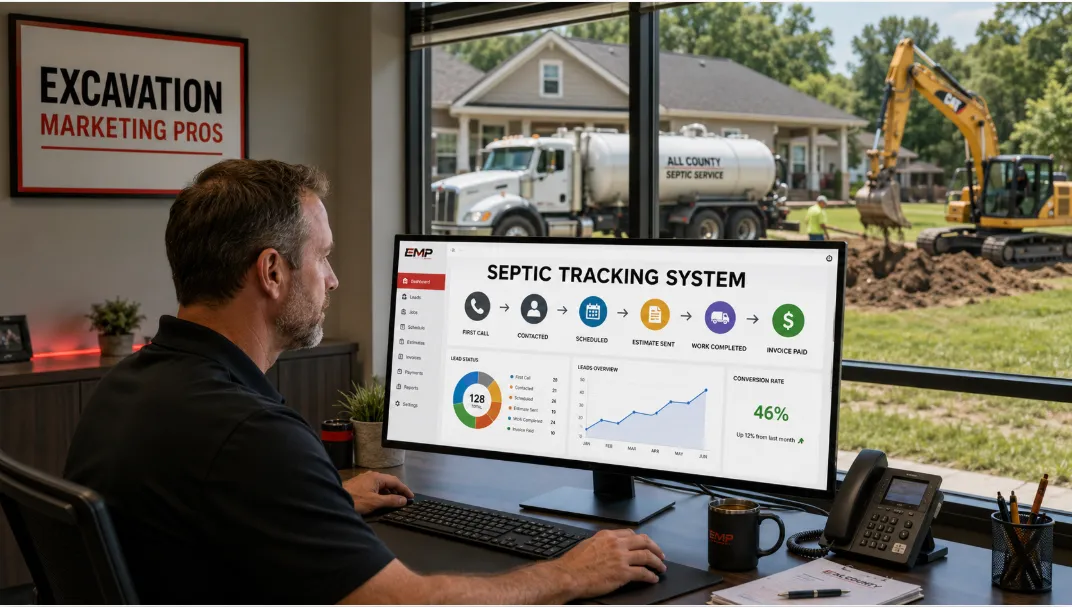
Call or form → CRM record → lead source → service type → booked appointment → estimate → completed job → paid invoice
That chain gives you the truth.
Without it, you are stuck with opinions.
The owner thinks Google Ads is working.
The office manager thinks referrals are best.
The tech says every good job comes from repeat customers.
The marketing report says organic traffic is up.
The bank account says, “Can someone please explain what is happening?”
Clean tracking ends the argument.
Step 1: Capture the First Call or Form Submission
The first step is making sure every lead gets captured.
That includes:
Phone calls from the website
Calls from Google Business Profile
Google Ads calls
Local Services Ads leads
Website form submissions
Chat messages
Facebook messages
Referral calls
Repeat customer requests
For many septic companies, the phone is still the main lead source. That means call tracking matters.
A good call tracking setup can show which source caused the phone to ring. For example, did the person call from a Google ad? Your organic website listing? Your Google Business Profile? A landing page?
That matters because the same phone call can look very different depending on where it came from.
A call from “septic pumping near me” may be urgent and ready to book.
A call from “new septic system cost” may need more education, more follow-up, and a better estimate process.
Both are valuable. They just need different handling.
The mistake is letting calls come in without tracking where they came from. Once that happens, the trail goes cold.
Step 2: Tag the Lead Source in Your CRM
Once the lead enters your system, the CRM should show the lead source.
Common septic lead sources include:
Google Ads
Google Business Profile
Organic search
Website form
Local Services Ads
Facebook
Referral
Repeat customer
Yard sign
Builder referral
HomeAdvisor or Angi
Direct mail
This field needs to be simple.
Do not give your office 47 source options. That creates confusion. Keep the list clean enough that your team can use it correctly on a busy Monday morning.
Lead source is one of the most important fields in your CRM because it tells you what is creating opportunity.
But remember, source alone is not enough.
A source that creates calls is not always the same as a source that creates revenue.
That is why the next steps matter.
Step 3: Record the Service Type the Customer Needs
Every lead should have a service type.
For septic companies, this may include:
Septic pumping
Septic repair
Septic inspection
Drain field repair
Septic installation
Septic design
Perc test
Riser installation
Maintenance plan
Emergency septic service
Grease trap service
Portable toilet rental
Service type gives context to the lead.
Without it, you are just counting names and phone numbers.
Let’s say you got 100 leads this month. That sounds useful, but it is still too vague.
A better report would say:
42 septic pumping leads
18 septic repair leads
9 install leads
6 perc test leads
11 inspection leads
14 portable toilet rental leads
Now you can make decisions.
Maybe you need more install leads. Maybe pumping is keeping trucks busy but not growing profit. Maybe portable toilet rentals need their own landing page. Maybe repair leads close better in certain towns.
Service type helps you see the shape of demand.
Step 4: Mark Whether the Lead Was Booked or Missed
This is where a lot of money disappears.
A lead comes in. The phone rings. Nobody answers. Or someone answers, but the customer is rushed. Or the caller says they need to talk to their spouse. Or the office says, “We’ll call you back,” and then the day explodes.
That lead may never become a job.
Your CRM should clearly show what happened.
Use simple statuses like:
New lead
Contacted
Missed call
Needs follow-up
Appointment booked
Estimate scheduled
Estimate sent
Won
Lost
Bad fit
No answer
This matters because not every marketing problem is a marketing problem.
Sometimes the ads are fine.
Sometimes the website is fine.
Sometimes the issue is missed calls, slow follow-up, weak notes, or no clear next step.
A septic customer with sewage backing up does not wait around forever. If they call three companies and one answers right away, that company has the advantage.
Tracking booked versus missed leads helps you see whether the leak is happening before the job even gets scheduled.
Step 5: Track the Appointment, Estimate, and Follow-Up
Once the lead is qualified, the next step is getting it on the calendar.
Your CRM should track:
Appointment date
Appointment type
Assigned technician or estimator
Estimate date
Estimate amount
Follow-up date
Follow-up status
This is especially important for high-ticket work.
A pumping job may be booked and completed quickly. But an install, drain field repair, or excavation project may take more steps.
The customer may need:
A site visit
Soil testing
Permit information
A written estimate
Financing options
Follow-up questions
A second conversation with a spouse or builder
If that process is not tracked, expensive opportunities slip through the cracks.
A $400 pumping job can usually be handled fast. A $15,000 install lead needs a system.
That does not mean it has to be fancy. It just needs to be clear.
Who owns the follow-up?
When is the next call?
Was the estimate sent?
Did the customer open it?
Did anyone follow up after three days?
Why did they not move forward?
These questions should not live in someone’s memory. They should live in the CRM.
Step 6: Connect the Completed Job to the Original Lead
This is the part many septic companies miss.
The job gets done, but the original lead source gets lost.
The tech completes the work. The customer signs off. The invoice gets created. Everyone moves on.
But if the CRM or invoice system does not connect the completed job back to the original lead, your marketing data breaks.
You might know the job happened.
You might know the invoice amount.
But you will not know whether that job came from Google Ads, organic search, Google Business Profile, referral, or repeat customer marketing.
That is a problem.
Because now your report says, “We got leads,” but it cannot prove which leads became money.
To fix this, your system needs a shared thread from the first call to the completed job.
That may happen inside one platform, or it may happen through connected tools. The exact setup depends on your business.
The key is simple:
Do not let the lead source disappear after the job is booked.
Step 7: Add the Paid Invoice Amount
This is where tracking becomes useful.
Not when the lead comes in.
Not when the phone rings.
Not even when the job is booked.
The real clarity comes when the paid invoice amount is connected to the original lead.
That lets you answer questions like:
How much revenue came from Google Ads?
How much revenue came from organic SEO?
Which cities produced the most revenue?
Which service types produced the most revenue?
Which campaigns brought calls but no money?
Which jobs were worth the follow-up effort?
Which sources created low-quality leads?
This is the difference between a marketing report and a business report.
A marketing report says:
“You got 91 calls this month.”
A business report says:
“You got 91 calls, 56 booked jobs, 43 completed jobs, and $68,400 in paid revenue. Google Business Profile produced the most call volume, but Google Ads produced the highest average job value because of repair and install leads.”
That second report is the one the owners want.
Because now you know what to do next.
Why Call Tracking Alone Is Not Enough
Call tracking is useful, but it is not the finish line.
A call is only the start.
A septic company does not grow because the phone rang. It grows because the right calls turned into booked, completed, paid work.
Here is the problem with stopping at call tracking:
Some calls are spam.
Some callers are outside your service area.
Some callers are price shopping.
Some calls are repeat customers.
Some calls never book.
Some jobs book but never close.
Some jobs close but are low profit.
Some jobs are huge and worth every dollar spent to get them.
If all you track is the call, you do not know the difference.
That is why revenue tracking matters.
It separates noise from money.
The Simple Lead-to-Revenue Tracking Chain Every Septic Company Needs
Here is the cleanest version of the system:
This does not need to be overbuilt.
Start simple. Make sure your team can actually use it. Then improve it over time.
The best CRM is not the one with the most features. It is the one your team updates correctly.
Example: How One Septic Repair Lead Moves Through the System
Let’s say a homeowner searches “septic repair near me” and clicks your Google ad.
They call your office.
Here is how that lead should move through the system:
First call: Captured by call tracking
Lead source: Google Ads
Service type: Septic repair
City: Bentonville
Lead status: Appointment booked
Appointment date: Tuesday at 10:00 AM
Estimate: $3,200
Follow-up: Customer approved same day
Job completed: Friday
Paid invoice: $3,450
Now your CRM can tell a useful story.
That was not just one lead.
It was a Google Ads lead that became a septic repair job in Bentonville worth $3,450.
Now multiply that by a month, a quarter, or a year.
Patterns start to show up.
Maybe Google Ads is great for repair work. Maybe organic search is best for pumping. Maybe builder referrals are best for installs. Maybe one city is eating up drive time and hurting profit.
You cannot see that clearly without tracking the full path.
Common Septic Lead Tracking Mistakes That Hide Revenue
Mistake #1: Tracking Leads but Not Booked Jobs
Lead volume is not enough. You need to know how many leads actually made it onto the schedule.
Mistake #2: Not Separating Service Types
Pumping, repair, install, and portable toilets should not be thrown into the same bucket. They have different values and different sales paths.
Mistake #3: Letting Office Notes Replace CRM Fields
Notes are helpful, but fields are reportable. “Customer needs repair” buried in a note is not as useful as selecting “Septic Repair” in a service type field.
Mistake #4: Not Tracking Lost Reasons
When jobs are lost, you need to know why. Was it the price? Timing? No follow-up? Outside service area? The competitor won? That information helps you fix the real issue.
Mistake #5: Stopping at the Estimate
An estimate is not revenue. Track whether it closed and whether the invoice was paid.
Mistake #6: Not Reviewing the Numbers Monthly
Tracking only helps if someone looks at the data. A simple monthly review can show where money is coming from and where leads are leaking.
How Better Tracking Helps Owners Make Smarter Marketing Decisions
When tracking is clean, decisions get easier.
You can decide where to spend more money.
You can stop paying for sources that do not produce revenue.
You can build better pages for profitable services.
You can train your office team around missed opportunities.
You can follow up better on high-value estimates.
You can see which cities deserve more attention.
You can separate busy work from profitable work.
That is the real win.
No more reports.
Better decisions.
A septic company with clean tracking can look at marketing differently. Instead of asking, “Did we get leads?” the owner can ask:
“Which leads made us money, and how do we get more of those?”
That is a much better question.
How Excavation Marketing Pros Think About Septic Lead Tracking
At Excavation Marketing Pros, we are not the biggest firm. We are not trying to be.
We are more interested in building tracking and marketing systems that fit the way septic and excavation companies actually operate.
Some companies have a strong office team. Some are owner-led. Some use a CRM every day. Some have a CRM that has basically become a junk drawer. Some care most about pumping volume. Others want installs, repairs, excavation jobs, portable toilet rentals, or maintenance plans.
The setup should match the business.
That is why we care about custom tracking.
A septic company with two trucks does not need the same system as a company with 20 trucks. A company chasing installs needs different reporting than one focused on pumping routes. A business with a strong repeat customer base should not track marketing the same way as one trying to break into new service areas.
The point is not to make tracking complicated.
The point is to make it useful.
Final Thoughts: Stop Guessing Which Leads Are Worth Paying For
Septic marketing gets a lot easier when you can follow the money.
A lead should not disappear after the phone call. It should move through a clear path:
First call → CRM record → booked job → estimate → completed work → paid invoice
When that path is tracked, you can finally see what is working.
You can see which sources bring real revenue.
You can see which services are worth pushing harder.
You can see where follow-up is weak.
You can see where good leads are being lost.
You can see whether your marketing is creating paid work or just activity.
That is the difference between guessing and running the business with clear numbers.
And for septic companies, clear numbers matter.
Because trucks are expensive. Labor is expensive. Fuel is expensive. Equipment is expensive. Missed calls are expensive. Bad leads are expensive.
You do not need a prettier report.
You need a report that tells you where the money came from.
Start with the first call. Track the lead source. Tag the service type. Mark the status. Follow the estimate. Connect the job. Add the paid invoice.
That is how you track a septic lead from first call to paid invoice.
Need help setting up a lead-to-invoice tracking system for your septic company? Contact Excavation Marketing Pros and we’ll walk you through what a simple, useful setup could look like.

HOW WE HELP DRIVE DEMOLITION SALES
Get Found!

We help Excavation Companies that sell demolition services to get more of their top money making services by getting found on search engines for those services.
Just imagine how it would impact your demolition business showing up in the organic search listings getting all the FREE clicks and high ticket leads for:
✔️House Demolition
✔️Shed Removal
✔️Interior Demolition
✔️Selective Demolition
✔️Mechanical Demolition
✔️Dismantling
✔️Deconstruction
Now compound that exposure in all the local surrounding areas where you operate...
Better yet, just focus on the ideal jobs you want more of and ONLY compound demolition leads for those!
That's just organic SEO... You can also dominate the Google Maps 3 Pack. The Google Maps section gets the lion-share of all the calls and contain your reviews and phone number.
Customer ROI Tracking!

We track everything and will show PROOF to you DOLLAR for DOLLAR where your demolition customers are coming from and your cost to acquire a new customer! This way you can make smarter decisions based on factual numbers .
"So how many leads are coming from your website or Facebook Ads or Google Ads?"
The common answer most business owners tell us is, "I got no idea." When asked, "How many new clients are coming from each marketing channel?" The response is almost always, "I got no clue."
Don't Worry... We got you! We know how to set up the right systems for demolition companies so you'll know EXACTLY where each client comes from AND the COST PER LEAD and COST PER CUSTOMER from EACH MARKETING CHANNEL! Armed with that kind of information helps you make better decisions for your business with less stress and headaches.
Skyrocket Demolition Sales!

Why should people hire your Demolition company instead of your nearest competitor? The common answer we here is, "Because I'm honest and provide a good service."
Look, every demolition company in your local area claims the SAME EXACT THING. What you need is a "USP." -Unique Selling Proposition.
We will give you one to tell your story and set yourself apart from the rest.
We'll give you proven CTAs "Calls To Action" based on current test data of what's working and the latest demolition marketing trends to compel your ideal demolition customers to want to hire you for the EXACT DEMOLITION SERVICES YOU WANT MORE OF!
Your Demolition Service Marketing Experts In Online Marketing 👷
We know the excavation business and for many in the industry, providing demolition service is part of what you do... When we wake up each morning we ask ourselves the same question, "How can we get better results for our excavation clients?" -We've gotten really good at answering that specific question! We get in, take action fast and produce the results based on your goals of where you're at and where you want to go.
IF YOU OWN A DEMOLITION COMPANY, PREPARE TO BE AMAZED!
But only if you take action and book a call.
Demolition Marketing Strategies & Systems⚙️
Are you ready to take your Demolition Company to the next level? Lets discuss your goals and get to know you and your business. Then we will put together a custom and detailed Demolition Accelerator Blueprint specific to your needs. You keep the blueprint whether we're a match to work together or not. $397.00 Value - Free for a limited time!

Our Motto

If We Can't Make Your EXCAVATIOn Company Money, We Don't Deserve Yours!
When you work with Exacavation Marketing Pros® you'll see that we're results driven, straight to the point and get the job done. Here's what our demolition clients love about us:
Fast Results, We'll Simply Plug You In To What Works... No Trial & Error!
Dedicated Account Manager... Unparalleled Custom Service Because We Love Our Customers❤️😊
100% Accountability, NO BS... We Provide A $1 MIL Revenue Guarantee.
Demolition Marketing Services

Proven Demolition Service Ad Campaigns, Ad Copy For Demolition Services
Nobody has the level of specific experience and campaign data for the excavation industry like we do. We'll target your ideal demolition service jobs on Google and Facebook. Then filter out the best leads and even do the follow up. By the time you get the lead it's of the highest quality.

Bullseye Targeting For Your Ideal Demolition Services
We can eliminate all the stress, trial and error for you... not to mention all the wasted time and money by trying "Generalist Marketers" or piecing together strategies on Youtube. You can skip the trial and error with us.

Web & Lead Analytics
You'll always know where your next client is coming from and have a predictable system in place for getting your ideal clients ON DEMAND.

Client Acquisition Data Analysis
This is fancy talk for knowing your cost per lead and cost to acquire a customer from each ad channel: Google, Facebook, organic SEO and so on... Watch us lower your cost to acquire a new customer from the web using methodical data analysis based on your cost per lead and cost per customer. See it all in your dashboard we give you in plain English.

Reputation Management
It's bidding a race to the bottom if your reputation doesn't hold weight! High quality clients want to see a solid reputation before spending the big money, am I right? So stop bidding lower prices then your competitors and increase your profitability and worth by proactively increasing 5 Star Reviews while mitigating bad reviews before they go public... We do all this for you.

Your Business Has A UniqueMedia Selling Proposition (USP)
Get ready to skyrocket sales to new levels based on your USP. We'll tell your unique story in a way to attract clients and set yourself apart from the competitors. You've got unique aspects to your business that your competitors don't have and cannot compete with... We'll find it and use it. Then ramp things up with Specials and Seasonal promotions that are guaranteed to yield a strong return on investment.

Here2Help, LLC dba Excavation Marketing Pros™
All Rights Reserved
ADDRESS: 19046 Bruce B. Downs Blvd., # 1045, Tampa, FL, 33647
Excavation Marketing Pros is a Licensed trademark with serial numbers:
98026399, 98095462, 98070982
BEST KNOWN FOR: Excavation Marketing, excavation leads, land clearing marketing, Excavation marketing services, excavation marketing contractor, Pool Excavation Leads, Septic Business Growth, Excavation Business Growth, Demolition Leads, Construction leads, Landscape Construction leads, Land Clearing Leads, Pond Leads, Septic Leads, Land Remediation Leads, Lot clearing Leads, Site Work Leads, Road Grading Leads, Heavy construction marketing, Septic tank install leads, septic contractor marketing
*
*Any and all guarantees will be discussed on our call and formalized in writing. Applies only to Septic Sales Tsunami Program, New Clients Only. Cetain restrictions may apply. Average setup time of 2 business days depends on pre-existing client online assets. See earnings disclaimer.
Facebook
Instagram
X
LinkedIn
Youtube
TikTok